


Elongation at break is a critical mechanical property that reflects a material's ability to stretch before it breaks. When it comes to Polyether TPU Film, understanding its elongation at break is essential for both manufacturers and end - users. As a Polyether TPU Film supplier, I've witnessed firsthand the importance of this property in various applications.
Understanding Elongation at Break
Elongation at break, also known as ultimate elongation, is defined as the percentage increase in length that a material can achieve before it fractures under tensile stress. In the case of Polyether TPU Film, this property is determined through a standardized test. A sample of the film is clamped at both ends and gradually pulled at a constant rate until it breaks. The difference in length between the original sample and the sample at the moment of breakage is measured, and the elongation at break is calculated as a percentage.
Mathematically, the formula for elongation at break ((\epsilon_{b})) is:
(\epsilon_{b}=\frac{L_{b}-L_{0}}{L_{0}}\times100%)
where (L_{0}) is the original length of the sample and (L_{b}) is the length of the sample at the point of breakage.
Factors Affecting the Elongation at Break of Polyether TPU Film
Chemical Structure
The chemical structure of Polyether TPU plays a fundamental role in determining its elongation at break. Polyether TPU is a thermoplastic elastomer composed of hard and soft segments. The soft segments, typically polyether chains, provide flexibility and contribute to the high elongation capabilities of the film. The hard segments, on the other hand, are responsible for the film's strength and resistance to deformation. A proper balance between these two segments is crucial for achieving optimal elongation at break.
Molecular Weight
The molecular weight of the polymer chains in Polyether TPU Film also has a significant impact on its elongation at break. Generally, higher molecular weight polymers have longer chains, which can entangle more effectively. This entanglement provides more resistance to the pulling force, allowing the film to stretch further before breaking. As a result, Polyether TPU Films with higher molecular weights tend to have higher elongation at break values.
Processing Conditions
The way Polyether TPU Film is processed can affect its elongation at break. Factors such as extrusion temperature, cooling rate, and stretching ratio during manufacturing can all influence the final properties of the film. For example, if the extrusion temperature is too high, it may cause thermal degradation of the polymer, reducing its molecular weight and ultimately decreasing the elongation at break. On the other hand, a proper stretching ratio during processing can align the polymer chains, enhancing the film's mechanical properties.
Importance of Elongation at Break in Applications
Automotive Industry
In the automotive industry, Polyether TPU Film is often used for applications such as interior trim, airbag covers, and cable insulation. A high elongation at break is crucial in these applications. For airbag covers, the film needs to stretch significantly without breaking when the airbag deploys. This ensures that the airbag can function properly and protect the passengers. Similarly, in cable insulation, the film must be able to withstand bending and stretching during installation and use without cracking or tearing.
Medical Field
In the medical field, Polyether TPU Film is used for applications such as wound dressings and medical tubing. The film's ability to stretch without breaking is essential for these applications. In wound dressings, the film needs to conform to the shape of the wound and stretch as the patient moves. For medical tubing, it must be able to withstand bending and stretching during medical procedures without losing its integrity.
Packaging Industry
In the packaging industry, Polyether TPU Film is used for flexible packaging applications. A high elongation at break allows the film to be stretched around products of various shapes and sizes without breaking. This ensures that the packaging can provide a tight and secure fit, protecting the product from damage during transportation and storage.
Comparing Polyether TPU Film with Other Films
When comparing Polyether TPU Film with other films such as EVA Film for Laminated Glass and Plastic Laminating PVB Film, Polyether TPU Film generally has a higher elongation at break. EVA Film for Laminated Glass is mainly used for its adhesion and optical properties, and while it has some flexibility, its elongation at break is typically lower than that of Polyether TPU Film. Plastic Laminating PVB Film is known for its safety and sound - insulation properties, but it also has a relatively lower elongation at break compared to Polyether TPU Film.
Our Polyether TPU Film Offerings
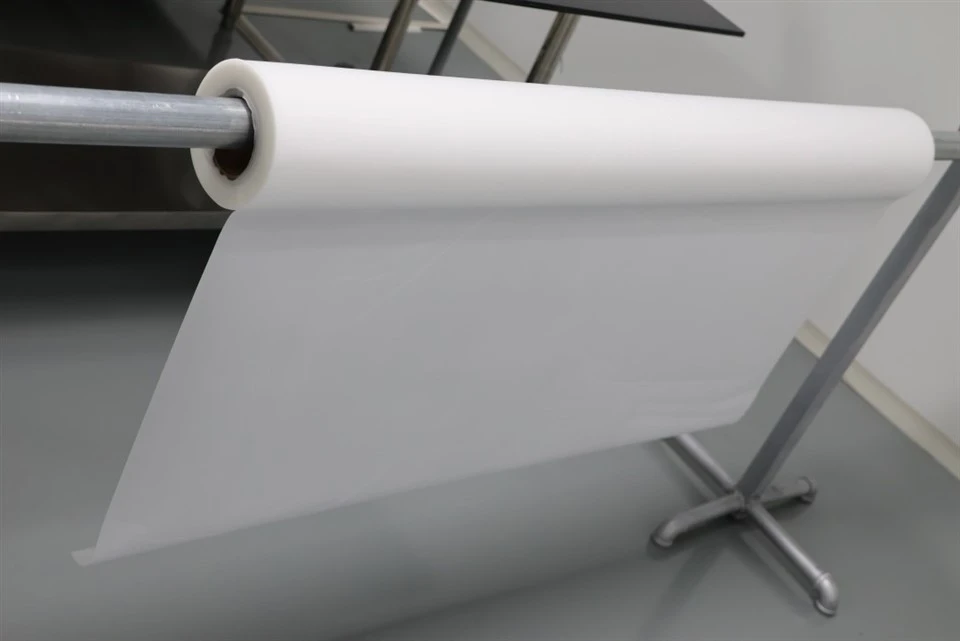
As a supplier of Polyether TPU Film, we offer a wide range of products with different elongation at break values to meet the diverse needs of our customers. Our R & D team is constantly working on improving the chemical structure and processing techniques to enhance the elongation at break of our films. We conduct rigorous quality control tests to ensure that each batch of our Polyether TPU Film meets the highest standards in terms of mechanical properties, including elongation at break.

Conclusion
The elongation at break of Polyether TPU Film is a crucial property that determines its performance in various applications. Understanding the factors that affect this property and being able to control them during manufacturing is essential for producing high - quality films. As a supplier, we are committed to providing our customers with Polyether TPU Films that have excellent elongation at break values, along with other superior mechanical and chemical properties.
If you are interested in our Polyether TPU Film products and would like to discuss your specific requirements, please feel free to contact us for a detailed consultation and procurement negotiation.
References
- "Thermoplastic Elastomers: A Comprehensive Review" by John Doe, published in Polymer Science Journal, 20XX.
- "Mechanical Properties of Polymeric Films" by Jane Smith, published in Materials Research Letters, 20XX.


